
GIRILAMBONE
The first houses in the town were built in 1880, after the discovery of copper and gold in the district. In 1875 Mr Hartman, whilst proceeding fromthe Bogan River to Cobar, camped at some “gilgai” water holes close to Girilambone Hill, and from his experience at Cobar, recognised the characteristic blue and green stainings of copper carbonates at the site of the present south shaft. In 1879 accompanied by his brother-in-law, Charles Campbell he marked out four 40 acre mineral conditional purchases, but this was disputed by W.W. & T.L.Richardson, on whose run the hill was. The mine was opened in 1880 by Mr Richardson. An article from the “Sydney Mail” dated March 18, 1883;
Few, doubtless, of the readers of the Mail have even heard of this, one of the latest and most promising of New South Wales townships. Twelve months back, Girilambone as a town was unknown, the name being significant but to a blackfellow, in whose lingo it stood, and for aught I know now stands, for the “place of falling star”.
Some 18 months back good prospects of copper were discovered, on the run of Mr T. G. Richardson, known as “Murrawombie”. A company has since been formed to work what has proved to be a rich mine, and already some £1000 or £1200 are paid monthly in wages, although no smelting is going on, the furnaces being only in the course of erection. The ore is said to be very rich, and what goes far to prove the assertion is that for some time no shares have been in the market, holders being willing only to part at a very considerable premium.
Then, too, Girilambone is on the main line of railway now in course of construction from Nyngan to Bourke, and the headquarters of the contractors is only two miles from the township. The firm of Mann, Carey and Co secured the contract, and already the work of clearing the line, cutting, fencing, etc., is going rapidly ahead.
I have seen many towns in their infancy in this and other colonies, but I never yet saw one with more signs of healthy vitality than this same Jerry-lamb-bone as the unsophisticated miners pronounce it. During the last month two banks have opened here – the Joint Stock and the Mercantile, and judging from the cheeriness of the bank managers’ faces, business is by no means dull. Then we boast of two hotels, both quite equal to ordinary country hotels, and superior to a very great many of your Sydney houses that I wot of.
The early closing law does not affect us much, as there are no police stationed here, although no doubt before long we shall boast our trooper, or perhaps two. What we want more than police and more than a parson even, is rain. Water, until a few weeks back, when a few inches of rain fell, was quoted at 2s. 6d. per cask, and if we do not have more within a week or ten days, the same quotation will rule again. There is plenty of provision made to hold rain when it comes, but you must catch your hare before you cook him.
The store of Sullivan, Wills and Co, is the great centre of business, it being to all intents and purposes the Exchange of the city. Pay-day is a great day here, and the amount of liquor imbibed per male adult (and in some cases you may fairly throw in a female or two) must entitle Girilambone to be ranked as a good revenue producing township.
Despite the want of water, grass is plentiful around here, and after coaching it from Dubbo to Nyngan, one cannot but feel relieved at the sight of a little verdure after a lot of desert. The population at this time is about 600 persons.
In 1896, the Girilambone Copper Mining Company Limited was formed and active operations begun, 200 men being employed. The main shaft was deepened to 320 ft and 17,154 tons of ore were raised during 1897 and 173 tons of copper produced. From the official records from 1881 to 1907, when the price of copper dropped and the mine closed, 1,141 tons of copper were produced.

After the mine closed, most of the population left, and those staying moved to the new town next to the railway line, which served the growing wool industry in the district.

school train 1965

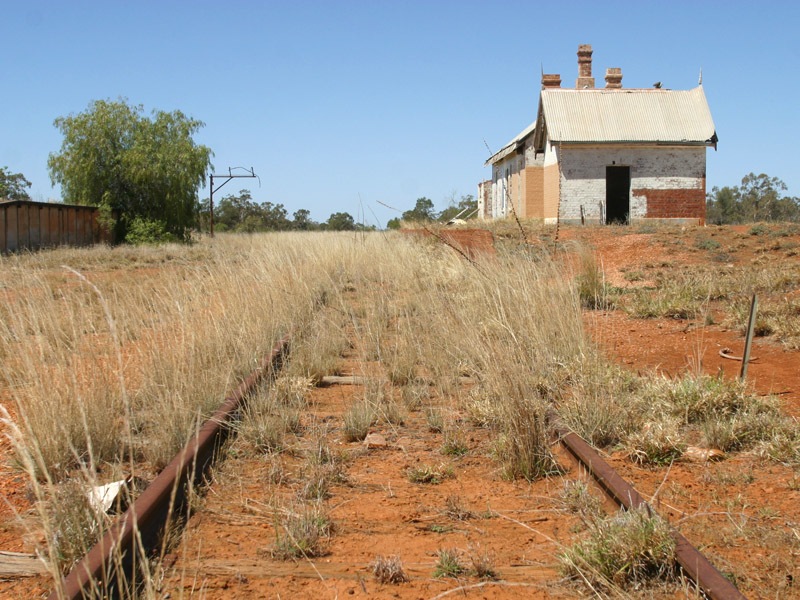
Girilambone Station 2025

Bruce Cady (teacher), from left to right, top row
Bruce Cottee, Bernadette Bartley, Sandra Thorpe, Suzanne Johnson, Dennis Thorpe, Marian Ferguson, Doug Larsen, Beryl Brown. Lesley Spicer, Terry Ramien, Adrian Johnson, Ray Brown.
2nd row. Brian Skinner, Dale Ryan, Judy Conway, Jean Chant, Mary Conway, Cheryl Dicker, Warwick Dicker, Owen Payne, George Skinner, Kevin Brown.
3rd row. Julie Gilhome, Jeff Brown, Narelle Larsen, Therese James, Warren Brown, Jeanette Cottee, Larry Gilhome, Norm Bartley, Shannon Ferguson, Carmel Payne, Patricia Cottee, Clair Skinner, Ron Morley and Ruth Chant.

Further Reading
Discovery of Girilambone and copper by Ken McQueen