
William Skinner
| William Skinner 1720-1771 and Margaret Wicks 1729-1800 |
| James Richard Skinner 1762-1829 and Mary Carpenter 1761-? |
| Jacob Skinner 1789-1827 and Phoebe Crampton 1789-1845 |
| James Skinner 1825-1882 and Julia Elizabeth Manwaring 1830-1859 |
| Julia Elizabeth Skinner 1856-1934 and Francis Ernest Thomas 1846-1931 |
James Richard Skinner was born in 1762 and baptised at Great Chart in Kent on the 4th of April of that year. James was the son of William Skinner (1720-1771) and Margaret Wicks (1729-1800) of Cranbrook, Kent.
James married Mary Carpenter on the 9th of April 1787 at the Church of St Mary the Virgin in Sellindge in Kent. On the marriage entry James is listed as being a bachelor from Beckley, Sussex and Mary a spinster from Sellindge. The witnesses to the marriage were Sarah Collings and Francis Godden.
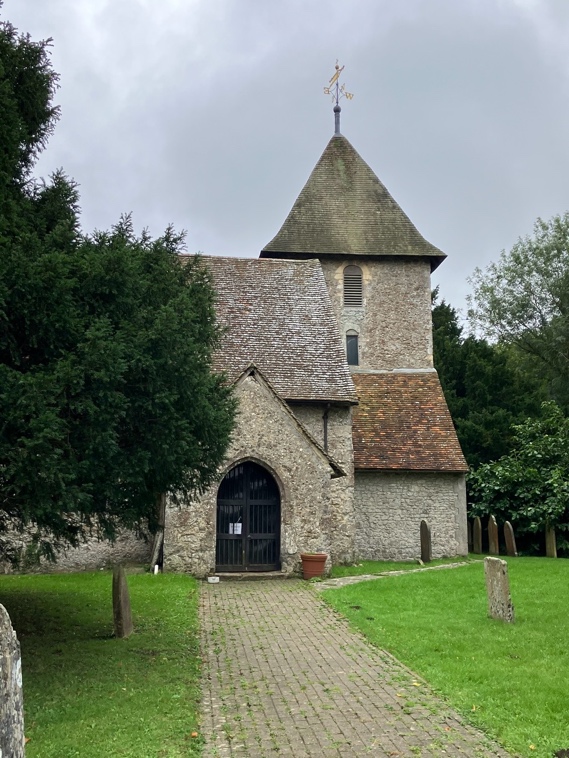
Church of St Mary The Virgin in Sellindge, where James Richard Skinner and Mary Carpenter married in 1787
Jacob, the first of James and Mary’s six children was born in 1789 in Cranbrook and was baptised in Sellindge on the 29th of March. The other five children (John b.1796, Richard b.1799, Catherine b.1801, Elizabeth b.,1804 and Thomas b.1806) were all born in Bethersden a small village about halfway between Cranbrook and Sellindge.
James died in November 1829 and was buried at Staplehurst, Kent on the 25th of November.
Jacob, James and Mary’s eldest child married Phoebe Crampton (1789-1845) on the 13th of January 1810.
St Dunstan’s church in Cranbrook, known locally as the Cathedral of the Weald. Where Jacob Skinner and Phoebe Crampton were married, and the resting place of Julia Elizabeth Manwaring (nee Skinner) and her son George Skinner.

Phoebe was born in Cranbrook, Kent and christened at St Dunstan’s Church on the 1st of June 1789.
St Dunstan’s features many times in this Skinner lineage. It was in that same church that Jacob and Phoebe were married. Records from the marriage show Jacob listed as a bachelor from Staplehurst, Kent, and Phoebe as a spinster.
Jacob and Phoebe must have stayed in Kent for at least the next 15 years, as their first four children (Susannah b.1814, Mary Ann b.1818, John b.1820 and Jacob b.1823) were all christened in Kent. The baptismal records for their fifth child James b.1825 are from the Parish of St George, Camberwell, Surrey (now part of London).
Jacob died in 1827 back in Staplehurst in Kent and was buried on the 30th September.
Jacob’s widow, Phoebe, remarried on May 1st 1828 to John Fenn in Maidstone, Kent at All Saints Church.
The 1841 census list a 70 year old John Fenn and 50 year old Phoebe Fenn living at Milkhouse St, Cranbrook with their 10 year old son Charles Fenn and Phoebe and Jacob’s 15 year old son, also named Jacob Skinner.
Phoebe died on the 25th of May 1845 and is buried alongside her sister Jane at St Mary’s in Fittenden in Kent. The following is part of a headstone from St Mary’s churchyard: –
In Memory of Jane: wife of William Hoad and daughter of Robert and Jane Crampton: aged (44 years) also of Phoebe: wife of John Finn and daughter of Robert and Jane Crampton who died May 25 1845 aged 56 years.
Jacob and Phoebe’s youngest son, James (1825-1882), married Julia Elizabeth Manwaring (1830-1859) in January 1849 in Cranbrook, only a few days after Julia had celebrated her 19th birthday.
Only 7 months after the wedding, the young couple’s first child George was born at Cranbrook on July 22nd, 1849. The second child, Mary Ann (the first of four daughters) was born soon after.
In the 1851 English census, James is listed as living in Hazelden Common near Cranbrook together with Julia, son George, and daughter Mary Ann. His occupation was recorded as an Agricultural Labourer.
Julia’s Parents, William Manwaring (1808-1902) and Sarah Judge (1807-1890) with their children, except for Julia, emigrated to Australia in 1857 aboard the Anna Maria which sailed from Southampton on the 9th of March with 220 other emigrants. It is not known why James and Julia didn’t emigrate to Australia along with the rest of the Manwaring’s. They may have wished to remain in Kent with their young family, or perhaps they didn’t want to risk Julia falling pregnant before or during the voyage.
In December 1858 Julia’s younger sister Caroline who had sailed on the Anna Maria to Australia with her parents and siblings (excluding Julia) paid a deposit of £18 to sponsor James, Julia and their five children to immigrate to Australia to join the rest of the family
Unfortunately, before the time came for their departure to Australia, tragedy struck the family with Julia and only son, George contracting Scarlet Fever, a highly contagious bacterial infection which is treatable today with anti-biotics but in mid eighteenth-century England killed thousands.
Julia died on the 15th of March 1859, and her first born child George also succumbed the very next day. On Julia’s death certificate, the cause of death was listed as Scarlet Fever and Violent Delirium.
Julia was buried on the 18th of March 1859 at St Dunstan’s, alongside her 9 year old son, George.
On the 7th of June 1859, less than three months after burying his wife and only son, James and his four girls departed Southampton on the ship Parsee and set off for Australia. The Parsee arrived in Sydney on the 14th of September 1859, 95 days after leaving England. James is listed on the ships documents as being 34 year old Church of England labourer who could read and write, with daughters Mary Ann 8, Ellen 6, Julia 3, Susannah 1.

The Parsee which carried the widower James Skinner and his four daughters to Australia in 1859.
After their arrival in 1857, Julia’s parents, William and Sarah Manwaring settled at Halfway Creek near Bungendore in SE NSW, and it’s likely that that was where James and his daughters initially headed after their arrival.
From Bungendore, Julia moved to the Monaro region with her father James when she was eight years old – that would have been around 1864. James stayed in the SE of NSW for a few years, as there are records from 1872 listing him as living in the Molonglo district and his occupation at this time was recorded as Gardener.
James eventually made his way back to Sydney and passed away on the 20th of February 1882 of cancer at the age of 58. He died at the Macquarie Street Asylum in Parramatta and was buried at St John’s Cemetery on the 21st of February, apparently alone and remote from any family members. How the horrific events of 1859 impacted poor James and potentially contributed to his decline will never be known.
Macquarie Street Asylum where James Skinner died in February 1882.

Julia stayed in the Monaro and married Francis Ernest Thomas on the 18th of October 1875.
Francis was born in Gundaroo in 1846, the youngest of three boys. Whilst little is known of his early life, Francis seems to have followed in the footsteps of his Irish convict father, and was a bit of an outlaw. Reference to Francis appears in the 1874 NSW Police Gazette which noted that cattle belonging to William McCansh from ‘Redbank’ near Jugiong are supposed to have been stolen by three brothers named Richard, Henry and Francis Thomas. Richard is about thirty years of age five foot eight inches high, stout build, fair hair, short bushy sandy beard. Henry is about 28 years of age, five feet eight or nine inches high, fair hair, sandy beard. Francis is about 26 years of age, five foot nine or ten inches high, fair hair, sandy beard, sharp features, gray eyes: natives of New South Wales. Supposed to have gone to Narranderra. No warrant issued.
If Francis did make off to Narranderra, he didn’t put down roots there as in 1875, he was living near Cooma.
The newlywed couple of Francis and Julia lived in Numeralla at Undoo – In Lauri Neal’s book ‘Cooma Country’ he states that… before a church was built at Numeralla small services used to be held at Undoo, the home of Frank Thomas. A little later Thomas put together a small church building with packing cases donated by Denny Roach.
The first of Francis and Julia’s children, Caroline Elizabeth Thomas was born in Numeralla in 1877. It’s likely that Caroline was named after Julia’s Aunt Caroline Elizabeth Arttett (nee Manwaring) who, in 1858 paid for Julia, her father and three sisters to emigrate to Australia on the Parsee. The couple’s last child, Esther, was born in 1898.
Francis seems to have been quite active in the local community. An article published The Manaro (sic) Mercury, and Cooma and Bombala Advertiser of Friday 9th of September 1898 details one social function that Francis hosted to raise money for the Church.
Life must have been busy in Numeralla for Francis and Julia, with children appearing every couple of years for the next 20 or so years. However, in 1900 Francis seems to have made a return to his cattle stealing days. The Queanbeyan Age of 27th October 1900 ran a story which stated….A case which incited considerable interest was one in which Frank Ernest Thomas, grazier of Undoo Station Numeralla was charged with stealing two heifers, the property of George Snodgrass from the Cooma Common on July 16. The evidence of the herdsman, Patrick Arnold, was that a number of cattle went missing from the common every Winter. He set a watch and had the Police stationed at a lane about half a mile from where the cattle camped. He saw the accused rouse up the cattle, drive them to a lane, about ten head in all, where Thomas was met by Constable Scott who questioned him. Accused said the cattle were running in front of him, and he was trying to pass them. The Constable said that the accused was on horseback, with a dog and a whip, and was driving the cattle, crossing the land from side to side behind them. He saw him come into the lane and drive them 100 yards when he arrested him. The jury after an hours retirement returned a verdict of guilty. Accused was remanded for sentence.
The 1900 Police Gazette noted that Frank Ernest Thomas received a sentence of two years hard labour at Goulburn Gaol for the theft of George Snodgrass’s cattle.
After serving his sentence, Francis must have returned to the Monaro as the 1913 electoral roll for the Monaro-Umaralla polling place lists both Francis and Julia living at ‘Elmsmere’ together with their son, Walter Harold Thomas (who would go on the become the Deputy Mayor of Penrith).
Goulburn was to feature again in Francis’ later life, as it would appear that he ended up as a patient at the Kenmore Mental Hospital in Goulburn, with records indicating that after his death on 1st February 1931 he was buried in the Hospital’s Cemetery.
Julia outlived Francis by a few years before she passed away on the 23rd of December 1934. The Sydney Morning herald of 7th Jan 1935 has a very brief obituary for Julia which simply says At Numeralla, Mrs Julia Elizabeth Thomas, widow of Frank E Thomas died aged 78. She was born in England and came to Monaro with her father James Skinner when she was eight years old. Julia was buried at Numeralla cemetery and interestingly the headstone for Julia which was commissioned by her children and grandchildren makes no mention of her husband, Francis
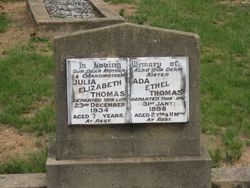
Julia Elizabeth Thomas (nee Skinner) gravestone at Numeralla cemetery.

Contributed by Craig Kentwell.