
Lewinsbrook Homestead
Alexander Park was born in Selkirk, Scotland. He came to Australia on the Prince Regent arriving on the 22nd March, 1826. Also on board the 527 ton ship were George Townshend and Charles Boydell, wealthy men from Wales. They all received land grants from Governor Darling in the Paterson River area. Alexander received a grant of 2650 acres which he called Lewinsbrook, Charles Boydell had a grant near present Gresford, which he called Camry Allyn, and George Townshend obtained a grant next to Lewinsbrook, which he called Trevallyn.
They also received assigned convicts, whom they had to clothe, feed and provide shelter for. In return the convicts had to work six days a week at whatever job was asked of them. The landowners served as magistrates and could sentence convicts for punishments, but not their own convicts. Charles Boydell estimated the cost of clothes and food for a convict for one year to be £17/12/- compared to a free worker at £41/18/- per year. The convicts lived in bark huts built by themselves, with about 4 to a hut. The landowners also lived in bark huts before more permanent buildings were put up.
James Davis Smith was assigned to Alexander Park in 1835 and stayed after he received his Conditional Pardon in 1849. He married Jane Parker in 1851 at Campsie and leased 36 acres from Alexander Park, where he built a bark house and grew tobacco. They moved to Singleton in 1875.

Lewinsbrook

Lewinsbrook Homestead

Lewinsbrook | Photograph by Jack Sullivan

Lewinsbrook Homestead
Gresford

Campsie map

“Campsie”

Allyn River “Campsie”

Dr. Robert Veitch Park also born in Selkirk in 1816 arrived in the Colony in 1837 and joined his brother Alexander on Lewinsbrook. Alexander never married but his brother married Miss Harriet Mary Boydell, the daughter of Charles Boydell and who was also the great grand daughter of John Blaxland, the explorer. Harriet was his junior by some 24 years and he was in fact in attendence at her birth. Their family consisted of eight children, four boys and four girls of whom all lived at “Lewinsbrook”. Dr. Robert Park, continued to live at Lewinsbrook until his death on the 14th of April, 1888, aged 73 years.

Alexander and Dr. Robert Park also had a sister Alison, who married James Dalglish a merchant from Columbia. The yet unnamed 1,280 acre property on the Allyn River north of Vacy was granted to Mary Tarpy in 1830 and she sold it to John Terry Hughes. After Hughes became bankrupt in 1843, Alexander Park of Lewinsbrook purchased the property on behalf of his sister Alison who had married James Dalglish in Campsie, Scotland in 1836 before emigrating to New South Wales. Alexander’s gift to Alison meant his sister and brother-in-law could setup home on their own land nearby, which they named “Campsie“. It was only a few kilometres downstream from Lewinsbrook.
.Campsie remained the residence of James snr and his wife Alison. He died at Campsie on the 10th June, 1864, followed by Alison on the 21st April, 1867. They are buried in St Paul’s cemetery, Paterson. After Alison’s death, Campsie was purchased by her sons James Campsie Dalglish and John Dalglish.
Campsie Public School opened in 1853 on the Campsie property, on two acres that James and Alison Dalglish gave to government. The school closed in 1859 and reopened in 1862. In early 1870 subscriptions were sought to build a new school at Campsie. Tenders were called in June 1870 and the new school building opened in early 1871. The school operated on and off until 1907 when it was renamed Trevallyn Public School. It finally closed in 1938. In 1944 the unused school building was moved to Eccleston where it replaced the previous school building. It was attached to the chimney and water tank of the old school. Eccleston Public School closed in 1986
The Hunter Valley Register records that Alexander Park died suddenly at Lewinsbrook and was buried in the St. Anne’s Church of England cemetery at Gresford in July of 1873.
On the 21st. of July 1873, Alexander Park passed away on Lewinsbrook. The following report was printed in the “Maitland Mercury” newspaper dated the 24 th. of July 1873.
“Death of the Honourable Alexander Park of Lewinsbrook. At a late hour on Monday evening the death of the Honourable Alexander Park was announced in town – but the full particulars of the melancholy event have not as yet been received. Mr. Park’s death must have been somewhat sudden as the lamented gentleman was in town on Tuesday of last week transacting business at the Land Office, and we have since heard that he was again in the town later in the week, either on Friday or Saturday, and was then apparently in his usual health. The late Mr. Park had attained an advanced age, as when we first knew him, now over thirty years ago, he was an elderly gentleman. Mr. Park was the largest land proprietor in the district, and owned the extensive Lewinsbrook vineyards. He for a short time was one of the representatives of the County of Durham in the Legislative Council having been returned for that constituted on the retirement of the Honourable Stuart Alexander Donaldson, but was rejected at the following general election, under the present constittion of responsible government. The funeral is to take place today (Wednesday) when he will be buried at the Gresford Church of England burial ground. The funeral, we learn will be a private one.”
The Maitland “Mercury” published the following article under the title “The Vineyards of the Northern District” with regard to “Lewinsbrook”, on the 30th. of December It is as follows;
“Another vineyard which has attained a wide-spread celebrity for its production is Lewinsbrook, which is situated upon the banks of a rivulet of the same name, a tributary to the Allyn River. It was planted by Mr. Alexander Park upwards of twenty years ago, and is the second largest vineyard in the Northern District, covering as it does an area of thirty acres, the vines in which were planted in one season. In March 1844, the ground now bearing this rich product was covered with timber and underwood. Before the following September it had been cleared, stumped, and otherwise prepared for receiving the vine cuttings intended for it, and before the end of the month 50,000 cuttings had replaced the forest. This fact indicates the great energy and enterprising spirit with which Mr. Park commenced the undertaking, and one which at the period of the colony’s existence was considered a work of considerable magnitude. Great care was bestowed on the vineyard in its infancy; it was dug throughout with the spade every year, and hoes were kept constantly at work in it; the vines were planted too close together to allow the plough to be used.
The result of the care bestowed upon it, and the high cultivation it received, was that in the fourth year of its existence 10,000 gallons of wine and 200 gallons of brandy were obtained from it at one vintage. Here, as at other places, several varieties of the grape were originally planted, but by degree many of them were found to be unsuited to the soil or situation, and they have been replaced by other kinds or by grafting from the vines that were most approved of in the vineyard. Where the old vines have been altogether removed the cuttings that replaced them have been planted wider apart – four or five feet between the vines, and seven feet between the rows, being the distances generally observed.
The vines thrive remarkably well, and the enterprise was very successful for several years after its commencement; but since the era of the gold discovery in 1851, Mr. Park assures us that the seasons have frequently been very disastrous – some years destroying the crop to such an extent that only 300 or 400 gallons would be obtained from the whole vineyard. The damage was chiefly done by hailstorms; but, not withstanding the frequency of these unwelcome visitants, and the discouragement then effects must have caused, the production of wine has been persevered in with much energy. We regret to state that it was only in the end of November last that a violent hailstorm, with the usual disastrous results visited Lewinsbrook, and cut up the vineyard in a most disheartening manner, completely destroying two-thirds of a very promising crop which the vines were bearing, and injuring the vines to such an extent as to affect their bearing next year. The storm was of brief duration and the hail about the size of marbles. Wet seasons when the grapes are just about fit to
gather, also prove very destructive, affecting not only the quantity of wine by rotting many of the berries, but also the quality. The vineyard however, will stand any quantity of rain or degree of heat up to the time of ripening, and not suffer in any way from it.
A large extent of the Lewinsbrook vineyard was originally planted with Burgundy, which, though making a most delicious and delicate wine, was a shy bearer and so susceptible of injury from rain when ripening that a crop could never be relied upon. It is therefore being gradually replaced with black hermitage. Shepherd’s Riesling, ( or seedling as it is sometimes designated ) and the Verdelho occupy a large share of the vineyard, they being considered here the best for white wine, and the black hermitage for red. Indeed, throughout the Paterson district those are the three varieties which are in every vineyard approved, and recommended to intending wine growers. There yet remain at Lewinsbrook several other sorts, which give fair crops that, yield a wine, which blends well with that of the choicer kinds. Stake training, and not espalier, is the system adopted throughout.
The situation of the vineyard is almost perfectly flat; the land has a slight dip inward from the brook to the hills forming the valley’s side. The aspect is favourable to the complete maturation of the crop, and the soil is especially well suited for vine culture; it is an alluvial loam, of a calcareous character, being strongly impregnated with limestone from the adjacent hills. The ranges hemming in the valley abound in limestone, and the decomposition of these hills, washed down with the rains, have made the land most valuable, by imparting to its calcareous character. In the possession of a soil of this kind, Mr. Park is very fortunate, as it has generally been deemed the best possible for the growth of good wine making grape. Most of the celebrated vineyards of Europe having soils of the same character.
At vintage time the greatest possible care is taken to make good wine – good quality and not large quantity being Mr. Park’s object. Every bad or mouldy berry is picked out by the grape- gatherers, as the bunches are plucked, and each basket is emptied onto boards, and again examined by Mr. Park, to see that all bad berries had been discarded before the grapes are put into the crushing machine. About three years ago a great loss was sustained at Lewinsbrook by the cellars being burnt down, and some 18,000 gallons of wine were destroyed by the occurrence, besides everything else the cellar contained.
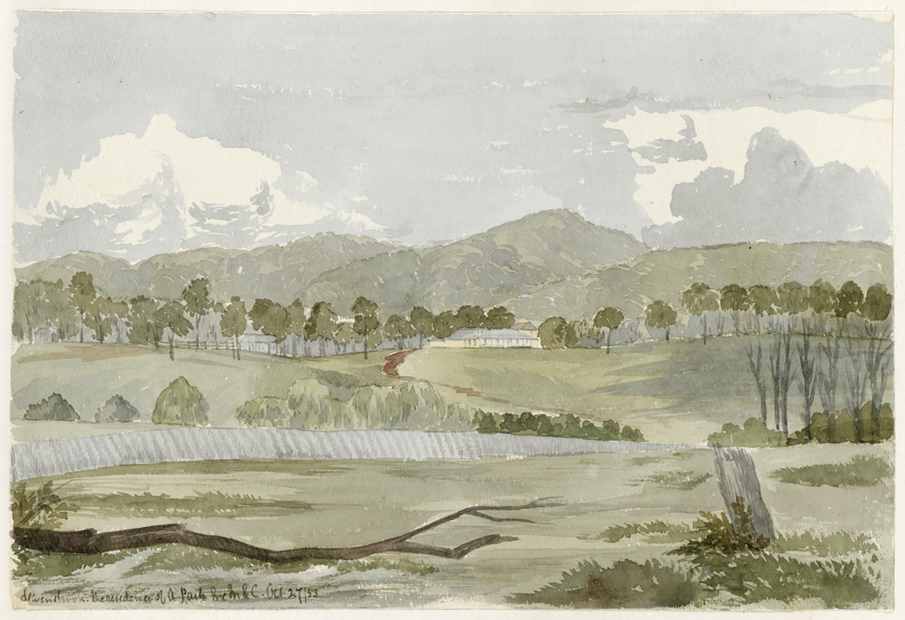
The cellar is built close to Lewinsbrook House, which stands on an eminence that
commands a fine view of the valley and the surrounding scenery. It is distant about a quarter of a mile from the nearest part of the vineyard, and about three-quarters of a mile from the furthest part. The cellar was erected of stone, and son after its destruction it was rebuilt, and again fitted with every necessary appliance for wine making. The walls when rebuilt were raised higher than they originally stood, and the upper part of the building was then made useful as a granary. The cellar measures eighty feet on the clear by forty feet in width; and, leaving room for the wine presses and other necessary apparatus for wine making, it is capable of containing about 40,000 gallons in wood.
One of the most noticeable features in the Lewinsbrook cellar is the enormous sized casks that are used. There are two capable of containing each from 1250 to 1300 gallons. These were imported from France at very considerable cost. On the model of these, Mr. Park is having a sufficient number of casks of the same size built on his premises, to range on each side of the cellar. He has five of them already completed, and two set up and in use. They are made of cedar two and a half inches thick, which is treated in the following manner.
After being sawn, it is placed in the brook, and allowed to remain there three months; it is then removed and allowed to dry for three or four months; after which it is worked up, and then again taken to the brook, filled with water and kept full for ten days; after that the cask is emptied, taken to the cellar, and after three days drying it is ready for use. Some fears were expressed by wine growers and others that the cedar would impart to the wines a disagreeable woody taste, but the treatment it underwent at Lewinsbrook before being used has made those fears groundless, and the wine in the casks which have been filled having sustained no damage whatever from the wood. The casks are made to stand upright, and when so fixed they are about 7 feet 6 inches in diameter at the base, and 6 feet 6 inches at the top. As the evaporation from so large a surface would be very great if the casks were allowed to stand perfectly level, Mr. Park has avoided this loss by fixing them at an angle of about 90 degrees, and thus but a small portion of the surface is liable to evaporation – indeed so little that an ordinary 250 gallon cask loses as much by evaporation as any one of these giants loses.
In making these casks great care has been observed to give the smoothest possible surface to the wood inside, the advantage of which is that when a cask is being cleaned no sediment can remain in any little roughness, as has been known to be the case with many other casks to the injury of the wine subsequently placed in them. For hooping, plate iron about four inches thick is used; there are six bands of this to each cask. There are a number of other casks of goodly dimensions in each cellar, and amongst them are three of 600 gallons each, and seven of 436 gallons each.
The cellar contains at present a large stock of wine, the vintage since the fire having accumulated and until lately being too young for the market. Mr. Park sells only in very large quantities; and the care bestowed on the Lewinsbrook wines has obtained a very fair demand.
We tasted some of the Shepherd’s Riesling of ’64 ( 1864 ), the Madeira or Verdelho of ’65 and the Hermitage of ’65. The Riesling was a beautiful light wine, clear and brilliant to the eye, and very pleasing to the palate. The Madeira was a wine of very high quality, possessing a rich generous flavour, combined with strength and a delightful aroma, beside which high priced Hock and Sauterne would not bear comparison. A bottle of burgundy about seven years old from one of a few cases saved from the fire, and was a splendid sample of wine, its rich and potent dryness proved how greatly the wines of this Colony improve with age. The Lewinsbrook wines promise to rank higher than they have hitherto done. On the estate, and the opposite bank of the brook, there is a fine orangery of several acres, which for years past has yielded large and never failing crops of that delicious fruit.
NOTES
The History of James Davis Smith by Donald A Readford.
History of the Williams River Valley https://williamsvalleyhistory.org/convicts/
The Maitland Mercury